Lessons From the Congo

By: Dayo Harris (Fourth Grade Teacher)

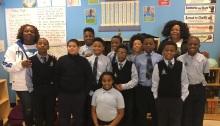
The opportunity to travel to the Democratic Republic of the Congo with a group of students this past summer was nothing short of amazing.  Over the course of our trip, I watched our students transform into engaged world travelers as they embraced a new culture and effortlessly connected with their Congolese peers.  Our students had spent the year learning French and studying the history of the Congo, including the brutalities of the Belgian exploitation of the region.  (In fact, they still make references to the Berlin Conference and the “Scramble for Africa” more frequently than you would imagine!) Because our social justice curriculum helped students develop a critical framework for understanding the current socio-economic disparities in the DRC, our travel objectives felt more significant than the typical cultural exchange trip.  We could not and did not arrive as simple tourists; rather, we embarked upon our journey as global citizens in solidarity with the struggles of the Congolese people.  To our astonishment, entire communities, whose leaders ceremoniously affirmed us as long lost brothers, sisters, and cousins, enthusiastically welcomed us as we traveled throughout the Congo.  This alone was an overwhelming and healing emotional experience—the impact of which cannot be measured.

Traveling to the DRC not only afforded our students with the opportunity to expand their experiential learning, but it also enabled our students to acquire a deeper perception of themselves as members of the African Diaspora. Students readily recognized many of  the commonalities between themselves and the people of the Congo while also noting some of the cultural contrasts. Increasingly, students began paralleling the various social disparities we were learning about in the Congo with the social inequalities they experience within their own Chicago communities.  Village Leadership Academy students were synthesizing information and critically evaluating our world by analyzing shared oppressions across borders.  More importantly, our students were compelled to action—their desire to work towards the eradication of social injustice both within their communities and in the world was palpable.  As a teacher, I was truly inspired by our students and the opportunity to witness the manifestation of our social justice curriculum goals within this international context.

Students remained invested learners and engaged problem-solvers throughout the duration of our trip.  Whether addressing the Minister of Education in Kinshasa or speaking with doctors at a resource-depleted hospital in Karawa, our students asked thought-provoking questions, often making connections between social justice concepts learned within the classroom and their real-world application.  VLA students were eager to go beyond discussion and often asked, “What can we do to help the people of the Congo?” Most of the time, people answered by stating that they wanted us to help counter Western media’s biased coverage of the DRC; they wanted us to share our travel experiences with others and to tell the world about the beauty of their culture, land, and people. Thus, our students have been sharing their stories both inside and outside of the classroom while finding relevant opportunities to identify with other marginalized  
peoples of the world. They continuously draw from the breadth of their travel experiences as they interpret the world around them and broaden their critical perspective, for Africa and the DRC remain an incalculable asset to our students’ learning and their understanding of social justice and self-determination.

We left the Democratic Republic of the Congo with a tangible sense of indebtedness to the people.  Collectively, we were fundamentally changed.  Our shared experience has helped to foster a greater sense of global responsibility as we teachers, students, administrators, and parents work together as a community to develop projects to help support our people of the Congo and to honor our commitment to social justice worldwide. (Please contact Village Leadership Academy if you’d like to help support our efforts.) As VLA students continue to learn about social justice and global advocacy, I am confident that they have the potential to radically transform our world, and I am thankful to be on this journey alongside them.

Take a look at this short film about VLA in the Congo.

Posted in Ms Harris | 2 Comments

Big Stories from Little People

By: Jess Pesola (Kindergarten Teacher)

We all have stories.  Stories that make us laugh, stories that make us cry, stories that make us laugh so hard we cry. Stories that are so painful we don’t dare say them out loud, and stories we think to ourselves- please never let me forget this one.

During a high school religion class, I remember reading this book, Ultimate Questions by Clyde F. Crews, and being struck by his words, “One of the oldest and deepest of human passions is the need to tell stories, and to hear them.”  And as a Kindergarten/1st grade teacher, it holds true, boy does it hold true.  Stories all day, every day.

So when our Kindergarten class sat down in front of a big empty sheet of chart paper to brainstorm our service learning project, it was no surprise that they filled the page with their stories.  I asked them what problems they see in their communities.  I asked them who they might want to help.  I asked them how they wanted to change the world. My students floored me with their responses –poignant, truthful, and articulate.  I never saw this kind of intention and language when they told me about their Grandma’s birthday or the time they went to Monkey Island.  My students transformed in front of my eyes into mature change makers.  It was like they were thinking about their topics all along and was just waiting for someone to ask them.

There was a heavy theme to the stories they were sharing.  Violence. 
 My Kindergarteners, the ones with 15 minute attention spans (and that’s with the assistance of puppets and other teacher bells and whistles), spent over an hour, -no frills- sharing with one another stories of how violence had affected them and their family.  They each listened with rapt attention that has never before been seen in a Kindergarten class, and probably would be impossible to duplicate.  For each story told, another 5 hands shot in the air.  They had endless stories to tell and had amazing clarity on the situation.  Their stories were powerful, and they knew it.

They told me about seeing a grandma getting robbed at gun point, walking into the burglary of their home, leaving the park abruptly because of gang shootings, watching a loved one consumed by alcohol and drugs.  Their stories kept coming, their eyes were wide, and their minds were open: open to the possibility of change. One student turned to her peers and said, “Hey guys, we should do a campaign to stop the violence.  That should be our project.  That way we could play in our parks and help people stop being shot and killed.”  The students all agreed. Others chimed in, “We could tell people our stories so they would stop and be nice to each other.”  “We can make posters with our faces.”  “We could teach people how to use their words when their angry and maybe they won’t hurt all those people.”  “Or wait, we have to tell people not to be in gangs.”  Tears came to my eyes.  Why did they know this?  How was it that they approached such serious subjects with such maturity?  It was amazing. It was the birth of our service learning project –The Stop the Violence Campaign.  They left that class feeling very powerful and proud.  I left feeling like that too.

Big things are going to come from these little people. I’m sure of it.

Posted in Ms Pesola | 1 Comment

Wait, There is More to Occupy?

By: Maria Wahlstrom (Instructional Coordinator)

Everyone is talking about Occupying Wall Street:
how the top 1% controls close to 40% of the wealth; how they dominate in decision making; and how all of this interferes with democracy (let alone human rights). When profit remains more valuable than people, it is no wonder the 99% get upset. Something is seriously wrong. So where do we start targeting to eliminate major inequality? Wall Street and their CEOs? Yes. But do the problems only reside on Wall Street? There is more to “occupy.”

Inequality not only begins with the corporate world, but in our schools as well. There is another (equally) serious problem that is rooted and perpetuated in our education systems–and I am glad  Village Leadership Academy (VLA) exists to help change this. Here are a couple articles on the issue (written by two people I have had the honor and pleasure to know and learn from). Ayers and Rotherham raise some important points and questions to consider.

1) Occupy Our Schools (By Rick Ayers)

2) Forget Wall Street: Go Occupy Your Local School District.  (By Andrew Rotherham)

Posted in Ms Wahlstrom | 2 Comments

Relearning School: An Educator’s Social Justice Journey

By: Maria Wahlstrom (Instructional Coordinator)

The Path. When I look back on my own elementary education, I realize my education was mostly marked with fear. I remember rows (of lines, of desks, and of ideas categorized as right and wrong). Whether I sat in the front or back impacted if I would be called upon or noticed. I remember feeling terrified to misread out loud or say the wrong thing in class, and worse: I remember if my test answer was marked “wrong,” I would feel my stomach sink along with the corners of my mouth. I remember “good students” and “bad students” and trying to figure out which one I was. I remember thinking there was one answer to my question, and the teacher usually had it. I remember associating red with “bad” as I watched my mistakes turn red. I remember fearing mistakes and forgetting their inevitable nature. I remember annoying subtle giggles echo my “silly questions,” (which I really wanted to know). I remember purposefully staying silent to avoid my teacher’s response.  Yes, I guess I had a reason to be afraid, not of school, but of mostly being wrong; of thinking differently. I now realize that my school actually taught the same lesson every year: there was a predefined box called intelligence, and all I had to do was find my way in it.

Coming from a privileged background of educated parents and consistent support, I somehow made it down the path of education. It wasn’t always easy for me, but everyone I knew pushed me through. Eventually, not only did I learn the rules of the school game, but I was lucky to learn to play it well. I believed winning would reward me with labels known as, “smart” or “successful.”  This prize would make me worth something. Isn’t that what we all learn in school? I believed in the game; I eventually succeeded in the game (even when it wasn’t easy to play). With privilege, I was able to squeeze tightly in the box. I learned the “right answers” of mainstream school of thought, so I began to see more red A’s than red mistakes. I knew the “intelligent answers” without question.  I learned to primarily value efficiency, without realizing its potential interference with human experience and equity. I learned success was school leading to money, so I too bookmarked these goals into my mental life trajectory. Yes–school turned out okay in the end–and I learned a lot. As a kid, I didn’t question what I learned; I didn’t dare question my teacher; or how school was implemented. Once I eventually found my way into the prize box, I didn’t critically think about it.  After all, I didn’t see the need.

The Turn. But looking back, this journey through and to “intelligence” coupled with my work at Village Leadership Academy (VLA) has now led me to question much of what I know. It has made me rethink the traditional path and find new ways of educating.

As a first year teacher a few years ago, I too believed traditional education worked because it somehow worked for me. I naturally forced it onto my students, in hopes that I was helping. But, I was increasingly disappointed to see that it didn’t produce independent and inspired thinkers/learners (despite their academic growth on test scores). So I gave the famous college talk, in hopes that it would trigger motivation. “If you do well in school, you can go to college and get a good job!” I enthusiastically told my kids. They replied with blank stares. To them, going to Chucky Cheese or Pump it Up was more inspiring than going to University. Although I still believe emphasizing college is important, it was clearly not enough.

There were deeper problems the college talk could not completely address. Aside from some challenges outside the classroom, I noticed  challenges within the classroom as well. First, students didn’t seem to “independently think” on test– which asked them to regurgitate information in a systematic way. Next, they didn’t always seem engaged with the text or context–which seldom represented their identities, cultures, or experiences. Furthermore, it took forever to get kids to want to share their independent ideas–in a classroom environment that predominately labeled silence as good behavior. Despite these limitations, outsiders would claim they were somehow “becoming smarter.” From a quantitative perspective, the test scores suggested they were improving at a good rate. Qualitatively, I quietly observed incremental problems with this traditional classroom. The numbers seemed right, but something else was missing. The path may have been producing readers and writers, but it wasn’t producing the inspired leaders our school and their communites demanded.

Village Leadership Academy challenged me to ask two questions: Should I force it? or rethink it? Little did I know I was about to embark on a new challenge: I needed to relearn school and team up with VLA to help rebuild a different school that works–for the population we teach.

More than ever, our kids needed to learn how to identify and face social, economic, and political injustices that started the achievement gap in the first place. We could not perpetuate these systems in the classroom and expect to “close the gap.” No wonder our Chicago achievement gap “hasn’t closed within the last 20 years” (according to the University of Chicago’s recent findings). We are trying to fix the problem with another problematic system. We rarely step back to critically evaluate whether or not we may in fact perpetuate these same systems in our teaching without knowing. We are educating kids who remain marginalized in American society and label them as “deviant,” but we hardly equip them with the empowerment and innovative skills needed to create their own change and confront injustice (or understand how these systems of injustice can follow them their whole lives, even after college). Instead, most schools equip students with increasing amounts of information and predefined procedures rather than actual thinking skills. They hope the consequences of injustice will change once students learn the information and leave their communities. But, it is too easy to indirectly emphasize to our kids that they should leave their communities rather than help rebuild them. It became incrementally evident that VLA had an important point overlooked in most education policy discussions: Social Justice is needed as much as Reading, Math, and Science. This had to be the foundation for school systems, educators and students.

The New Road. I would love to take you– as the reader– through the rest of this mental journey of “relearning school” (a journey that has occupied my mind for the last couple of years at VLA). However, the process has been long, ongoing, enlightening, frustrating, and not to mention: uncomfortable. It has pushed me to think outside of norms–outside of my own privileged experience–and refocus on the underlying implications of schooling, especially for children of color. This journey has been marked with long debates, subsequent mistakes, periodic successes, some research, and (honestly) the journey hasn’t ended yet. Nonetheless, the realizations I have acquired so far are worth noting. As I experienced this journey of relearning school, I began to realize the box of “intelligence” and the path of education was too narrow in traditional elementary schools. Not only did I learn the importance of social justice education (from my school, my experience, and various influences), but I am also learning what it entails. Specifically, here are a few thoughts I have gathered along the way:

1) A Social Justice Education goes beyond test standards: it encourages children to critically think and never fear wrong answers.  While an emphasis on testing encourages thinking in the box, an emphasis on social justice encourages thinking outside of it. As one teacher stated in this Huffington Post article, “When we teach or model the expected process, we set up outcomes that determine a child’s thinking.” Through traditional schooling–which primarily emphasizes testing–children already sense that there is probably a correct answer you may be looking for. Children learn to look for correct answers and procedures before exploring the beauty in different and possibly “wrong and new ideas.” (Note: Now, I am not saying there is no such thing as a “correct answer.” I am just noting that it is also important for students to explore their own thinking process than sprint ahead to a predefined destination–which usually results from an overemphasis on testing). It is important for educators to allow students to do the work (the thinking) and not fear the process or mistakes along the way. After all, this is usually the reality of real world problem solving. Students should develop their ability to see many ways of doing things, rather than one. Feeling confident to think outside the box, whatever box that may be, is a skill within itself. When they navigate this process, not only are they able to know what they think, but more importantly, why they think it. We must create a classroom environment that allows kids the space to practice listening to each others ideas, forming their own ideas, articulating them, defending them, and having the courage to abandon them for something even better. This is when learning truly becomes their own process and journey.  In a social justice classroom, critical thinking is the focus, and fear is the enemy. After all, aren’t social justice concepts born from thinking outside the norms?

2)A Social Justice Education goes beyond first month introductions: it emphasizes identity all year round and constantly encourages children  to use every context to help them have a deeper understanding of  themselves. While traditional classrooms may limit identity topics to the first week or month of the school year, a social justice classroom emphasizes identity all year round. It places students as the center of their own learning. This type of educations asks them to constantly find ways to relate to what they learn. For example, rather than identifying only mere facts, they reflect on: 1) how do these concepts shape them?; 2) what can they learn from these concepts in their own lives?; 3) how can they further these concepts to benefit the world? They not only learn subjects, but they also learn how those subjects affect who they are and what they can do.

3) A Social Justice Education goes beyond eurocentricity: it emphasizes global history, perspectives, cultures, and current events of every region. It takes a holistic approach on viewing the world, its history, and its cultures. If you look through world history textbooks, you most likely find the majority of chapters are allocated to Europe and America and written from their perspectives (Loewen). For example, the title such as “Discovering the New World”– which implies the area was only “new” to those who did not already reside in the region–clearly gives a limited one-sided viewpoint of history.  This skewed eurocentric view of world history has limited our knowledge on the rest of the world. We do not want our students to learn only one type of history (which was never told from the perspectives of their heritage and culture, and certainly not in the interest of it). Teaching a holistic global story using multiple perspectives is important to social justice education because it increases the likelihood of cultural understanding and respect. It also allows children to see how oppression and social change manifest themselves differently throughout time and throughout all regions of the world. If ignorance is one prerequisite for injustice, then we must not perpetuate cultural and global ignorance within our classrooms. As Linda Salvucci, the vice chair of the National Council for History Education, recently stated about traditional social studies classrooms and curriculum: “People tend to think that history is only memorizing facts. More importantly, it is a way of thinking and organizing the world.” With this point in mind, we cannot stay divided as citizens of the world while memorizing one-sided facts and perspectives. Rather, we must seek to understand and respect (even if we don’t agree with) other perspectives, experiences, and lessons before we can truly seek peace. We should allow our students to do the same.

4) Social Justice Education goes beyond silent classrooms: it empowers children to speak up and collaborate. Social justice learning is NOT a quiet process. It encourages thought provoking student-centered discussions and allows students to deeply question (to the best of their ability) what they think, hear, and read. Instead of silent and teacher centered classrooms, social justice classrooms are loud because students lead discussions with questions and thoughtful responses. Students work collaboratively to find answers or rethink what they know. They ask questions during reading, and they are encouraged to identify perspectives during any event. Teachers facilitate the uncovering of critical learning and relearning, rather than dictate it. The classroom emphasizes that knowledge is never finite, answers remain relative (depending on perspective), and seeking justice is an ongoing process. Thus, classroom discussions are fluid, challenging, and never silenced.

5) A Social Justice Education goes beyond classroom walls: it gives children opportunities to utilize skills and knowledge outside the classroom and apply it to the real world.  Rather than only giving the traditional message of “learning will be important later in life because it will help you go to college,” social justice education gives the additional message that “you can develop your skills by using what you learn now to help make needed change.” Social justice education should not only discuss culturally and socially relevant issues that students face, but it should also give them opportunities to problem solve through these issues with social action (or service learning projects). Rather than talking about hypothetical word problems, children think deeper about real problems they observe or experience. They practice problem solving in real life situations through various subject areas. When children see how they are important to the world through social action, then they begin to believe in themselves and the potentials of their learning. They start to feel important and understand their own value.

Looking Back. Perhaps we all need to constantly reflect on what, how, and why we teach. Let’s start with ourselves as educators and uncover social justice in our own teaching. As social justice educators we need to question the systems of our teaching. We need to be mindful that we are not perpetuating the same messages of being quiet and fearing “wrong answers.” Educators, even with best intentions, can still easily miseducate if they are not always reflecting on the implications of the structure and systems that define, and can consequently confine their classroom environments.

Although I have learned a lot at VLA, I am still relearning education. I have started to see the need for different ways to educate and empower. My passion for social change has widened while working at VLA– not only for change in the world, but also for change in the way we practice as educators. When you are pushed to relearn education, you start to realize the new path may feel bleak at first, but it is possible and even necessary.

This journey begins once we have the courage and the drive to make the turn.

Posted in Ms Wahlstrom | 4 Comments

Move Towards Social Action: Empowerment through Physical Education

By: Vernon Lindsay (Capoeira/Physical Education Instructor)

Teaching Social Justice is an ongoing and holistic effort, rather than a 50 minute time block in the academic day. We use Physical Education, such as Capoeira (a Afro-Brazilian Martial Art), as an opportunity to teach children resistance and social justice concepts. Village Leadership Academy & Capoeira Akebelan will be presenting, A Closer Look at How Culturally Relevant Physical Education Empowers Youth and Promotes Social Action at the University of Illinois Chicago (UIC) Summit. This event will be held on November 5 (details on the brochure). If you are in the Chicago area, please come by and check us out!

Village Leadership Academy Capoeira Performance 2011

Posted in Instructor Lindsay | Leave a comment

NBC: VLA Principal Discusses the Real Pressing Issues Facing Education

 Nakisha Hobbs (Principal)

On May 1st, 2011, NBC-5 TV held an Education Nation Teacher Town Hall in Chicago. Watch principal, Nakisha Hobbs, briefly explain some of the issues facing education–which Village Leadership Academy is working on directly addressing. Big thanks to Deborah Olivia Brown for inviting the VLA!

Posted in Ms Hobbs | Leave a comment

“Changing Education Paradigms:” A Thought Worth Considering

By: Maria Wahlstrom (Instructional Coordinator)

Ken Robinson’s talk on Changing Education Paradigms has an excellent point for restructuring our schools. I highly recommend checking it out:

As Ken Robinson pointed out, rethinking HOW we teach is only one part of the puzzle to fixing education. I believe the other part involves questions of WHAT we teach, and HOW we empower our student to use their unique knowledge and skills to positively impact the world. Village Leadership Academy is excited to begin another school year as we continue to challenge current education paradigms and seek new ways to educate and move our students toward their fullest potential in the world.

I will leave these ideas for another blog coming soon…

Posted in Ms Wahlstrom, Uncategorized | 1 Comment